





















I play golf for a myriad of reasons. One is the neverending challenge and the occasional pat on the head from the golf gods with that sub-eighty score. Another is feasting on the inexhaustible array of course designs, landscapes, styles, and terrains. Enjoying the companionship of my playing partners is important as well.
Above it all is getting some great exercise and the simple act of slinging a minimalist carry bag on my shoulder, setting off on a four-hour walk, and embracing nature.
In 2018, I started writing a book built around walking 18 of the best courses in the Carolinas, venues that have a vibrant walking culture, and a good story to tell. The result was published in 2021 and is titled Good Walks—Rediscovering the Soul of Golf at 18 Top Carolinas Courses.
Two of the chapters featured longstanding stops on the PGA TOUR—Harbour Town Golf Links on Hilton Head Island, S.C., and Sedgefield Country Club in Greensboro, N.C. Thankfully, golfers on the PGA TOUR are still required to walk.
Sedgefield was designed by the Scottish architect Donald Ross and opened in 1925 and has an intimate, graceful, old-world feel. It was the co-venue for the Greater Greensboro Open on the PGA TOUR along with Starmount Forest from the tournament’s inception in 1938 through 1960. The tournament was held at Sedgefield alone from 1961-76, and the latest iteration of the tournament, now the Wyndham Championship, has been held at Sedgefield since 2008.
Chris Deinlein is 80 years old and has lived on the eleventh hole at Sedgefield since 1986 and is such a traditional and “old soul” in the golf arena that he’s played the game only with vintage hickory-shafted clubs since 2006.
“What a joy this course is to walk,” he says. “It can tax you, particularly going up the hill on thirteen. That one gets me. I’ve had hip and knee replacements, so I’m fortunate I can still walk. But I’ll keep doing it as often and long as I can.
“I truly think that walking is part of the game. My gosh—what do we play it for? The enjoyment of going out and hitting the ball and just being outside and walking to me is an integral part of it. I particularly love it late in the afternoon. You can see the contours with the way the sun is working on the ground.”
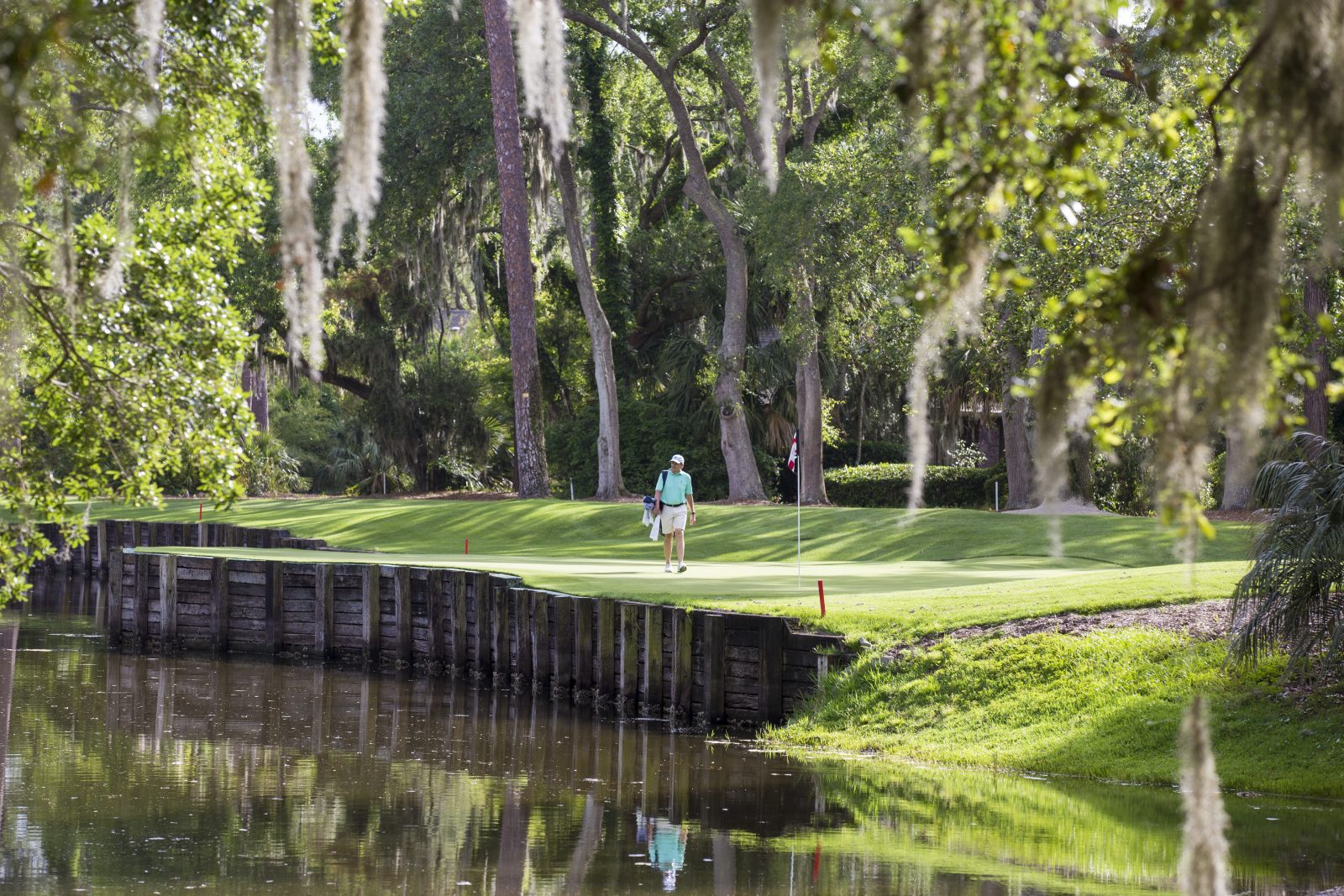
A rite of spring each April on the tour is a trip to Sea Pines Plantation and its Harbour Town Golf Links, which opened in 1969 and has been the venue for the RBC Heritage Classic since day one. Pete Dye routed the course on a gentle piece of ground on the southwest corner of the 41 square-mile barrier island. There are plenty of houses along the holes, but the setbacks are generous and the distances between holes modest. And management supports a healthy walking culture. Lug it. Push it. Hand it off to a caddie.
“We have kind of a heightened sense of awareness as we’ve seen the other side to it,” says John Farrell, the resort’s director of golf. “[Mandatory cards] is just
not the way to do it. If you’re physically able, the way to play is to walk. It’s the easy way to roll. Here we’re at sea level, the proximity of greens to tees is good, it’s better socially, and obviously it’s better physically. There are so many benefits to walking I can’t see why you wouldn’t.”
There’s nothing like a stroll through the South Carolina Low Country, lugging your bag on the parthree 17th with Calibogue Sound as a backdrop and then finishing with the grand red-and-white striped lighthouse behind the 18th green. Clubs clinking and wind whistling, you can almost hear Shivas Irons in his Scottish brogue from Golf in the Kingdom—“Ye’re makin’ a great mistake if ye think the gemme is meant for the shots. The gemme is meant for walkin’.”
This was first published in Essential Golf – you can read the complete magazine here.