





















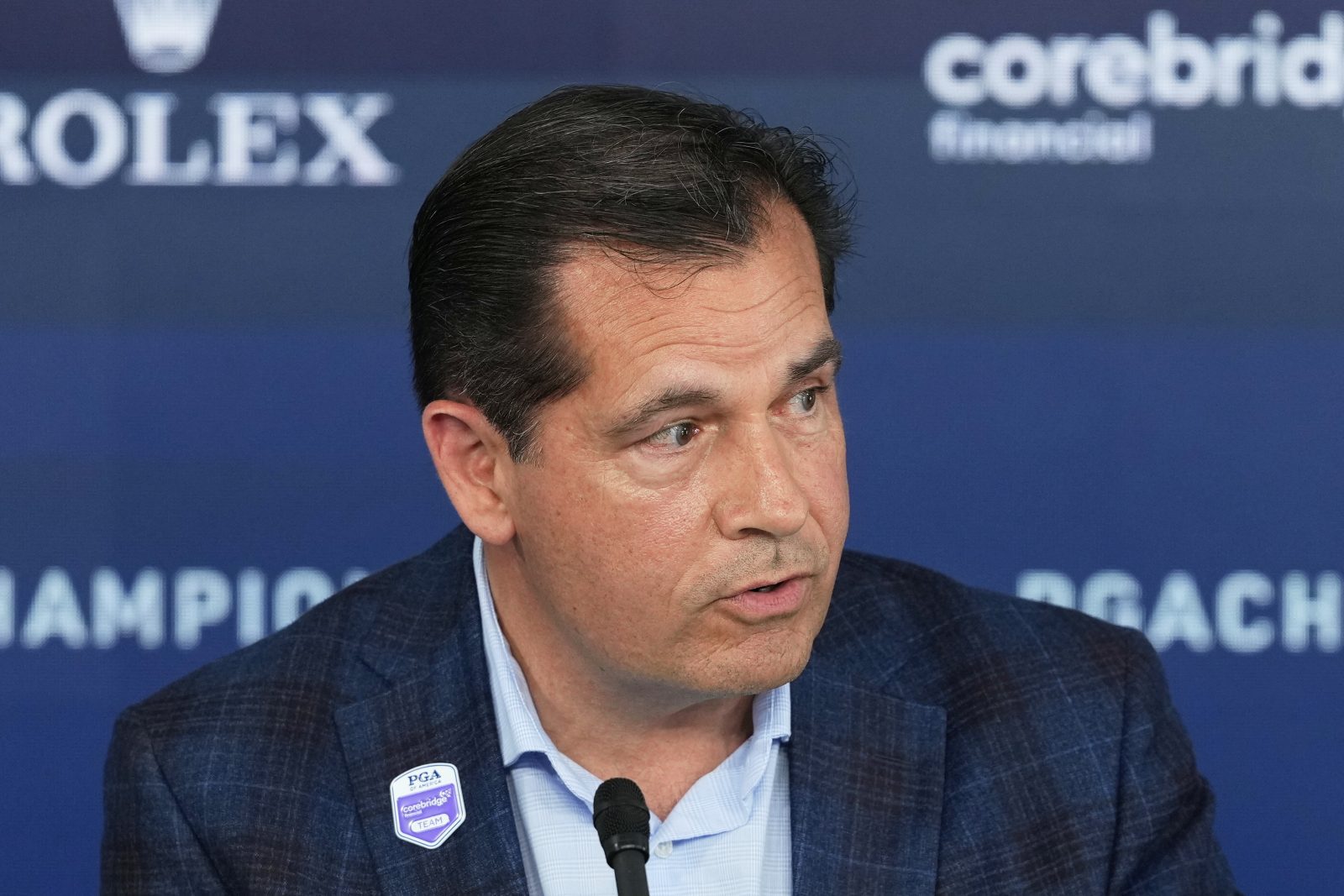
As Derek Sprague celebrates his one-year anniversary as PGA of America CEO in December, the veteran golf executive has been busy addressing inappropriate fan behavior at the 2025 Ryder Cup, particularly targeting Rory McIlroy and wife Erica Stoll.
Sprague, the first PGA of America CEO to have served as PGA president, wrote a lengthy letter to the McIlroys condemning the abuse and behavior at Bethpage Black they endured.
“I’m the CEO now. I don’t condone this type of behavior,” Sprague told The Athletic in early October. “This is not good for the game of golf. It’s not good for the Ryder Cup. It’s not good for any of the professional athletes, and we will do better.”
Shortly after the start of the 2025 Ryder Cup on September 26, Sprague sat down for an intimate roundtable discussion with media, including Essential Golf, on behalf of Rolex, a Ryder Cup partner since 1995.
Q: You’re nearly one year into your new job—and you’re also a former President of the PGA of America, which is the first time that’s happened—so how honored do you feel to have this position and how excited are you about this Ryder Cup?
SPRAGUE: I’m originally from Malone, New York, so I’m a long-time New York resident. I live in Dallas, Texas now, but our new headquarters are in Frisco, which is about 30 miles north of Dallas. I was on the board (of the PGA of America), probably the Vice President in 2013, when we announced this site, so that was a quick 12 years to go from 2013 to see it in reality now, and I didn’t realize I’d be back in this new seat. I knew my days on the board were over and I was fortunate enough to be announced as the President in 2016, and then I went to work for the PGA TOUR and ran the Presidents Cup in 2017 at Liberty National, and then ran seven editions of THE PLAYERS Championship. Now, to come back and have our team and be part of The Ryder Cup here at Bethpage, which I announced 12 years ago, it’s pretty cool to see it all come to life.
Q: There have been recent changes in leadership at the PGA of America, PGA TOUR, The R&A and LPGA. What does it say about the state of the industry that there has been so much turnover with the governing bodies, and how do you come in with fresh eyeballs and fresh ideas to engage the game?
SPRAGUE: That’s a great question, but I think having a fresh perspective is healthy for any organization and for the sport of golf. I just finished an hour-long meeting with Mark Darbon from The R&A. We both started in January, and we’re both committed to having more conversations about the sport worldwide and really trying to improve our governance structure. … I think a fresh perspective is good for the game because it brings different ideas to the sport – whether it’s music on the first tee or new formats like PGA Junior League to get youth into the game where they can play with their friends and have their names on their shirts. We got that idea and format from soccer. Soccer is big here—not as big as in Europe—but it’s big in this country as well and growing rapidly. Seeing all the kids in youth soccer in this country made me think that it would look good if we had their names and numbers on their jerseys, while playing with their friends.
Growing up, I played a lot of golf alone with adults. My mother always thought that the golf course was the safest playground in America, and I think that’s another great trait of our sport – it’s safe and it matures young individuals quicker, because they’re playing with adults a lot of times and people from older generations. That’s the beauty of our sport.
Coming out of the pandemic, we’ve seen this incredible growth. We’re seeing rounds of golf like never before – 550 million, I think, in this country played in 2024. When everybody was cooped up in their homes in 2020, the PGA of America worked hard to keep golf open in this country to be able to go out and play. I know it varied around the world, and different states in this country had different restrictions and measures in place, but we worked really hard to keep it open, and then all of a sudden you had grandparents playing with their kids and grandparents playing with their grandkids, and they’re going out there playing in a safe environment.
I said five years ago that this was going to be good for the game and retention, because golf is a sport that you can participate in at the time. Very rarely do you see moms and dads, and grandparents, running around a soccer field with their grandkids or their young children, but you’ll see them on a golf course together. I think that helps the retention rate in our sport, and that’s why we’re seeing such incredible numbers now of 28 million golfers and 550 million rounds of golf being played, so it’s all coming together.
Q: There’s a certain sense that there’s still an elitism around golf, and golf is becoming almost more like a luxury product as time goes by. What does that do for the accessibility of the sport when you’re appealing to new generations who might look at golf as being too expensive to get into?
SPRAGUE: The ticket prices are consistent with other major sports that are played in this market here. We look at that, the size of the build-out and what we have for space for hospitality, and price our tickets accordingly. In terms of the partnership with Rolex, I don’t see us saying that it’s an elitist sport. Rolex helps grow the game globally, and it’s not just the wealthy that are taking up golf. People are aspiring to take up the game.
When you have events like The Ryder Cup here, and they’re seeing the excitement around the sport with music on the first tee and a different vibe, we’re seeing The Ryder Cup evolve, and I think Rolex are seeing the trends in this sport evolve as well, and they’re keeping up with those trends. It has really been a tremendous partnership in that regard because we’re evolving, Rolex are evolving, and they’re bringing more people into the game through this partnership.
Q: Guy Kinnings said that, in Rome, around 60% of the tickets were sold to people under the age of 40. Is there a similar split here?
SPRAGUE: While I don’t have those demographics off the top of my head here, I can tell you that by just looking at the fans, it’s a nice mix of the younger generation under 40, and I would think that it sounds pretty consistent. The highest growth segments in our sport are women and youth, and I think that aligns with where we’re going. It’s very exciting, and Rolex has been a big part of helping grow the game globally.
Note: This interview has been edited for length and clarity